

If you've been following the latest developments in open-source AI, you may have come across MOSS-Image, a new image generation model family from OpenMOSS-Team. With both projects using the name MOSS, developers have understandably asked whether OpenMOSS and Moss at Moss.dev are related.
They're separate projects building different parts of the AI stack.
OpenMOSS focuses on open-weight generative AI models, including MOSS-Image for image generation. Moss at Moss.dev builds high-performance semantic search and retrieval infrastructure for real-time AI applications, including voice agents and conversational AI.
Here's what each project does, how they differ, and where Moss fits into the modern AI stack.
What Is OpenMOSS?
OpenMOSS is an AI project focused on open-weight generative models. Its MOSS-Image model family is designed for image generation, including workflows that use structured layouts and precise control over visual elements.
The MOSS-Image release has attracted attention from developers exploring local image generation and diffusion-based workflows.
Key capabilities include:
- Image generation: Creating images from prompts using diffusion models.
- Layout control: Using structured spatial information to control the placement of objects and text.
- Local inference workflows: Making models available through community tools and integrations, including ComfyUI.
For developers building generative AI applications, OpenMOSS provides models and related artifacts for experimentation and deployment.
What Is Moss at Moss.dev?
Moss at Moss.dev builds real-time semantic search and retrieval infrastructure for AI agents.
When an AI agent answers a question, it often needs to retrieve relevant information from a knowledge base, conversation history, documentation, or other data sources before generating a response. Traditional retrieval architectures frequently rely on remote vector databases, introducing additional network latency into the process.
Moss takes a different approach: run semantic search where your AI application runs, rather than adding another network hop to every retrieval request.
Moss delivers sub-10ms semantic retrieval designed for latency-sensitive applications, including voice AI, conversational agents, AI copilots, and on-device AI.
Built with Rust and WebAssembly, Moss's local-first search runtime allows semantic indices to run in environments such as browsers, devices, edge infrastructure, and cloud applications.
Moss helps developers:
- Retrieve context in under 10ms: Reduce the time AI agents spend waiting for search results.
- Eliminate remote retrieval calls: Run search directly within the application's execution environment.
- Build more responsive voice AI: Retrieve relevant context without introducing unnecessary pauses into conversations.
- Reduce infrastructure complexity: Add semantic search without operating a separate vector database for supported retrieval workloads.
- Deploy across environments: Run search in the browser, on devices, at the edge, or in the cloud.
For teams building production AI systems, retrieval latency can directly affect the user experience. Moss makes fast, contextual search a part of the application runtime.
OpenMOSS vs. Moss at Moss.dev: Key Differences
Although their names are similar, OpenMOSS and Moss serve different purposes.
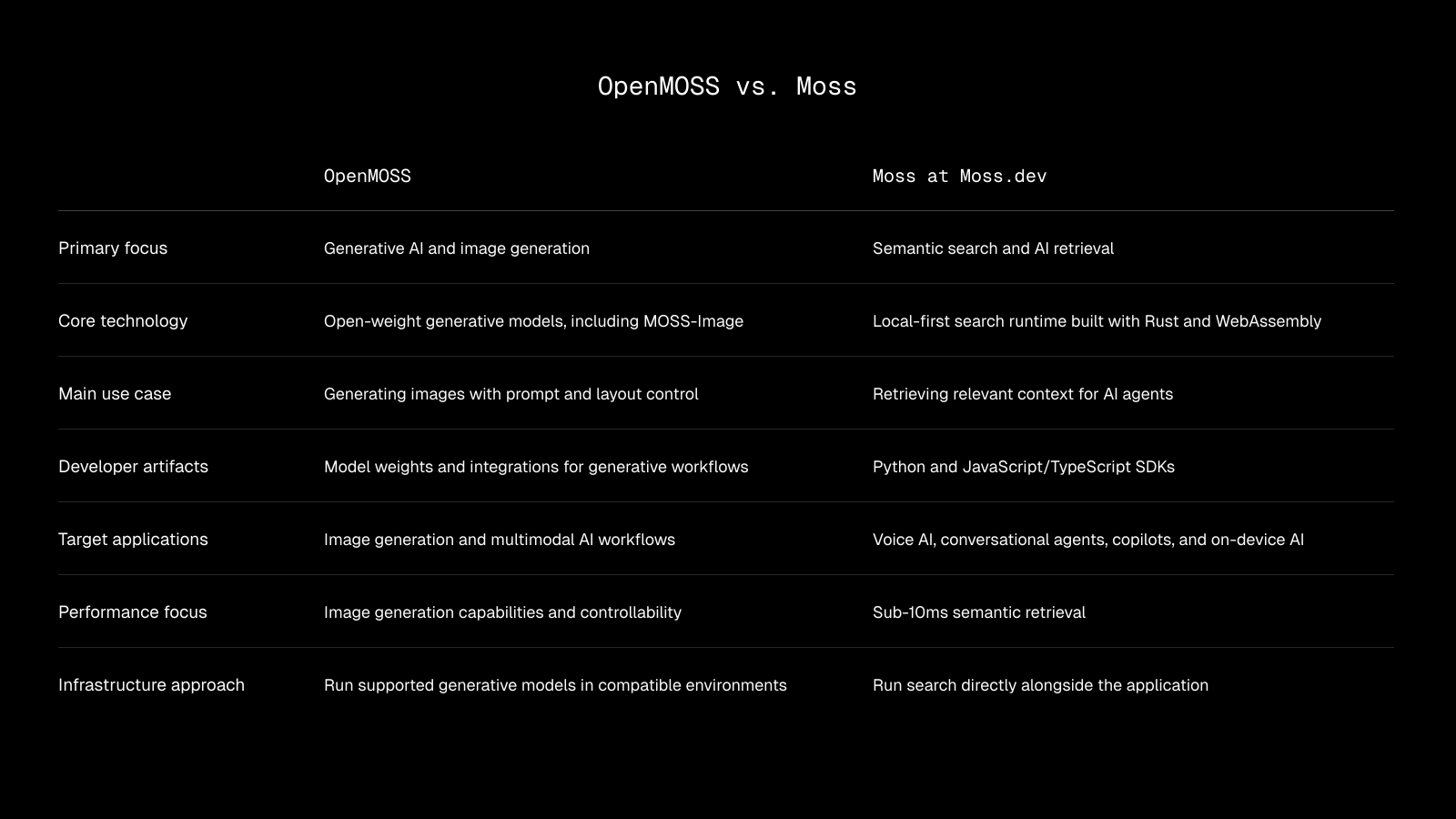
The simplest way to think about the distinction is that OpenMOSS helps developers generate images, while Moss helps AI applications find the right information quickly.
Why Retrieval Latency Matters for Real-Time AI
For many AI applications, generating a response is only one part of the process. The application may first need to identify the user's intent, retrieve relevant context, and pass that information to a language model.
Every additional step can increase the time it takes to respond.
This is particularly important for voice AI. When a person speaks to an AI agent, long pauses can make the interaction feel unnatural. Even if the language model itself is fast, a slow retrieval layer can delay the entire response.
Traditional retrieval architectures often send queries to a remote vector database and wait for results to return. These network round trips can become a significant source of latency in production systems.
Moss reduces this overhead by bringing semantic search into the application's runtime. Instead of making every retrieval request depend on a separate remote search service, developers can retrieve context locally in single-digit milliseconds.
This architecture is useful for applications where responsiveness matters, including:
- Voice AI agents that need to retrieve information while speaking with users.
- Customer support assistants that search product documentation and company knowledge bases.
- AI copilots that retrieve relevant project information, user history, and documentation.
- On-device AI applications that need local search without a constant cloud connection.
- Conversational AI systems that need fast access to context across multiple turns.
For these applications, fast retrieval isn't simply a backend optimization. It can directly influence how responsive and natural the product feels.
How Moss Fits Into the AI Stack
Modern AI applications combine multiple components, including language models, speech processing, tools, memory, and retrieval.
Moss focuses on the retrieval layer, helping applications find the information their models need without adding unnecessary latency to the execution path.
Developers can integrate Moss into their existing AI stack rather than replacing their language model or rebuilding their application around a new framework.
Moss provides Python and JavaScript/TypeScript SDKs and supports integrations with tools and frameworks used to build AI applications.
Whether you're building a voice agent, an AI copilot, or an application that needs local semantic search, Moss is designed to make retrieval fast without requiring a separate remote vector database for supported workloads.
Building Real-Time AI Applications?
OpenMOSS and Moss at Moss.dev address different challenges in AI development. OpenMOSS focuses on generative models, while Moss focuses on the retrieval infrastructure behind contextual AI applications.
If you're building voice AI, conversational agents, or other latency-sensitive AI systems, Moss delivers semantic retrieval in under 10ms with a local-first architecture that runs where your application runs.
Explore Moss at Moss.dev:
- Explore Moss to learn about real-time semantic search.
- Read the documentation to get started with the SDKs.
- Explore the benchmarks to compare retrieval latency.
- Explore Moss use cases to see how Moss supports real-time AI applications.


