

Moss built Founding Agent because we had a problem on our own website.
We were getting more traffic, publishing more content, and adding more information about our products and infrastructure, but visitors still had to do the work of figuring out where to look and what to read. If someone wanted to know whether Moss supported their use case, how an integration worked, or whether our infrastructure was relevant to what they were building, they had to find the answer themselves. At the same time, we were a lean team and kept seeing many of the same questions come up in conversations with prospects.
So we put a voice AI agent on our own website.
It started as a way to demonstrate what Moss infrastructure could do. We weren't thinking about it as a product, and we weren't even calling it Founding Agent yet. We just wanted people to experience a voice AI agent firsthand rather than read about one.
But once it went live, visitors started using it to actually learn about Moss. They asked questions, followed up on answers, explored our products, and eventually started reaching out to ask if they could put the same experience on their own websites.
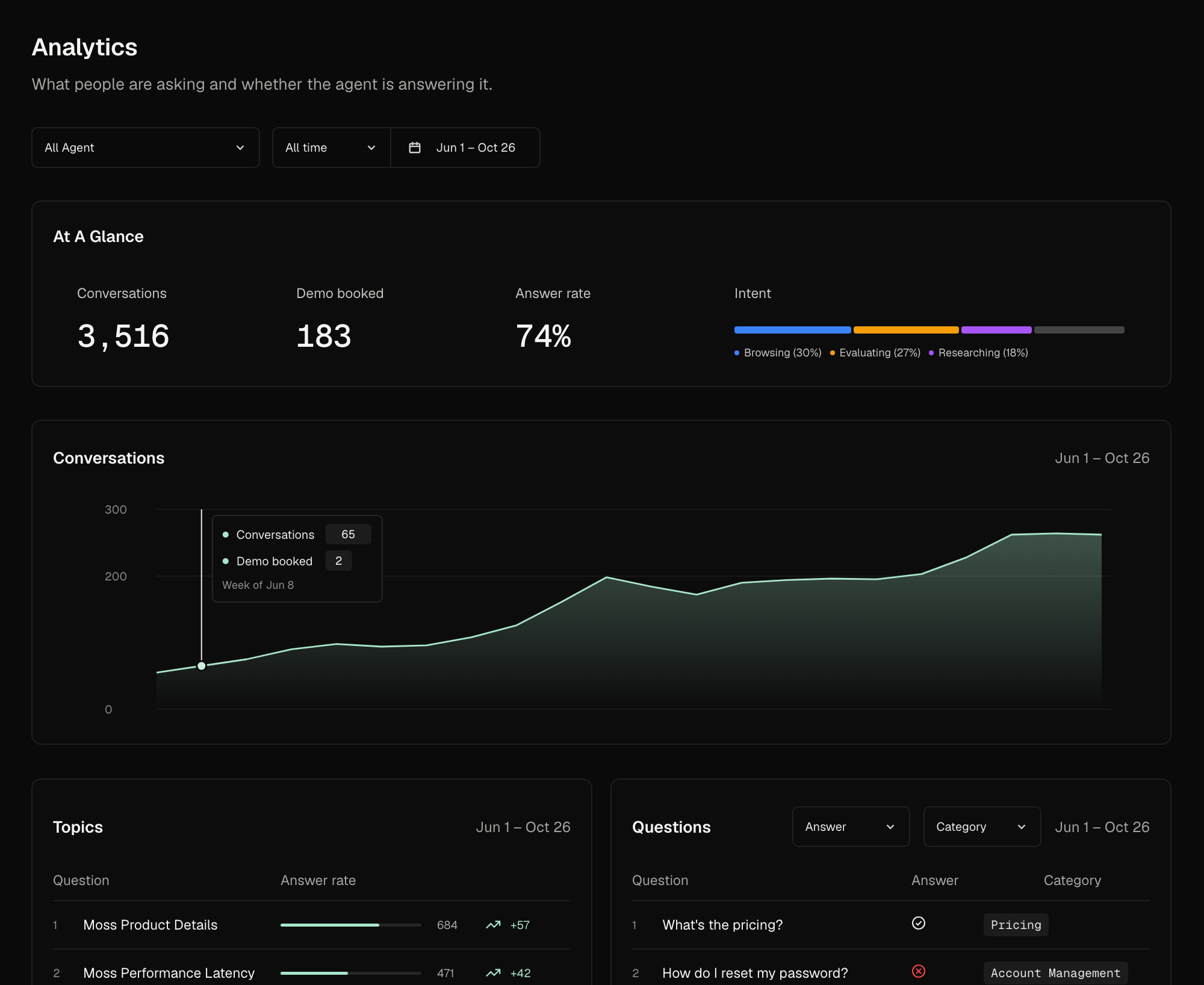
Over five months, Founding Agent handled 3,516 conversations and more than 9,500 interactions with visitors, representing approximately 120 hours of live voice conversation without a human on the call. Across those conversations, visitors asked 3,733 questions, and about 74% were answered from our knowledge base without human involvement. 61% of conversations happened outside business hours, including evenings and weekends in Pacific time.
We also saw a 4x increase in demo bookings, with much higher intent to convert. Visitors weren't just engaging with the agent. They were using it to understand whether Moss was right for them and taking the next step when they were ready to talk.
What started as a demo became something we used to run our own website. And the more we used it, the more we learned about what people actually wanted when they came to Moss.
The problem with making websites easier to navigate
For years, we've made websites better by adding more navigation, more landing pages, better documentation, smarter forms, and more content. But there is still a fundamental problem with that model: the visitor has to do the work.
They have to figure out which page to visit, decide whether the answer they're looking for is in the product page, documentation, blog, FAQ, or somewhere else, and then piece together the information themselves. If they can't find it, they either leave or reach out to someone on the team.
That was something I kept seeing with Moss. We had information about our products and infrastructure in a lot of different places, and we were constantly adding more, but more information doesn't necessarily make it easier for someone to understand what you do. A visitor might have one very specific question and have no idea where the answer lives.
The idea behind Founding Agent was simple: people don't necessarily want to navigate their way to an answer. They want to ask a question and get an answer.
Instead of asking visitors to figure out where the information was, we could let them ask for it directly.
3,516 conversations in five months
When we first launched the agent, we weren't expecting thousands of conversations. The initial goal was simply to show people what a voice agent running on Moss could actually do.
Ashvath Suresh Kumar, Founding Engineer at Moss, was one of the people working closely on it. The first version wasn't designed to be productized at all. It was essentially an extension of our core infrastructure that we could put on the website to demonstrate our voice AI capabilities.
Then we started seeing more inbound.
People were spending more time on the website, talking to the agent, and reaching out to us asking how it worked and whether they could use something similar on their own websites. Over five months, those interactions added up to 3,516 conversations and 9,500+ interactions.
But the number itself wasn't actually the most interesting part. It was what was happening inside those conversations. Traditional website analytics can tell me that someone visited a page, clicked a button, or spent five minutes reading something. But it doesn't necessarily tell me what they were trying to figure out.
A conversation does.
Someone might ask whether Moss works with a particular framework, how our retrieval works, whether Moss is relevant for a particular AI application, or how an integration works. Those questions give us context that a page view doesn't.
And when the same question comes up repeatedly, it tells us something about our website too. Maybe the answer isn't easy enough to find. Maybe we need a better FAQ. Maybe we need to explain the product differently. Maybe there is a blog post or landing page we should create.
The conversations gave us a way to see that directly.
3,733 questions: Turning conversations into GTM insights
Across those 3,516 conversations, visitors asked 3,733 questions. The conversations quickly became useful for something beyond answering questions. I started looking at them as a source of GTM insights.
We can see the questions visitors ask most often, the topics those questions fall into, and the questions the agent couldn't answer. If someone asks about a particular use case, that tells us what they're trying to build. If people keep asking about the same integration, that's a signal that we may need to make that integration easier to find. If visitors repeatedly ask a question we thought was obvious, maybe the problem isn't the visitor. Maybe our messaging isn't as clear as we thought it was.
That is a very different kind of feedback from looking at website traffic.
Before Founding Agent, a lot of our understanding came from a combination of analytics, sales conversations, customer calls, and our own assumptions. Now we can also look at what people are literally asking us, across thousands of real conversations.
That has changed how I think about the Moss website. If the same question comes up over and over again, I don't just want the agent to answer it. I want to ask whether we should fix the underlying problem on the website.
The agent can answer the question today. Our website should eventually make the question easier to answer without one.
74% answered: Building a knowledge loop
Visitors asked 3,733 questions, and approximately 74% were answered directly from the knowledge base without human involvement.
That number matters because we didn't want Founding Agent to simply produce an answer to everything someone asked. If the information wasn't available, we wanted the agent to acknowledge that rather than make something up.
The unanswered questions became useful in their own right.
When we saw something the agent couldn't answer, we could look at why. Was the information missing entirely? Did we have the answer somewhere but hadn't added it to the knowledge base? Was there something about the way we'd structured our content that made it difficult to retrieve?
That created a feedback loop we hadn't really had before. Visitors ask questions, Founding Agent answers what it knows, the questions it can't answer show us where the gaps are, and we add the missing information. The next visitor gets a better answer.
It also changes how I think about content.
Instead of creating content only because we think a topic might be useful, we can see what people are actually trying to understand. A repeated question can become an FAQ. A more complicated question can become a blog post or webinar. A recurring point of confusion can tell us that a product page needs to be rewritten.
The agent is consuming our content, but the conversations are also helping us decide what content we need next.
From answering questions to understanding buying intent
Answering questions was only the beginning.
Not every visitor who comes to the Moss website needs to talk to someone. Some people are researching, some have a technical question, some are trying to figure out whether Moss is relevant for their use case, and some are ready to talk to the team.
Founding Agent gives us a way to understand that difference. Every conversation can be captured as a lead with a summary, contact details when the visitor provides them, an intent label, and a lead score.
The intent labels range from Ready to buy, Evaluating, Researching, Browsing, Support, and Not a fit, giving us context around a conversation that a page view or form submission doesn't.
Someone who asks one technical question and leaves is very different from someone who spends several minutes talking through their use case, asks about pricing, and wants to book a meeting. We can see that difference, which means we don't have to treat every conversation like a sales opportunity.
This is one of the parts of Founding Agent that has become particularly valuable from a GTM perspective. The website is no longer just a place where people read about the product. It becomes another source of qualification and customer insights.
Letting the conversation become the lead flow
This also changed how we think about lead capture.
We didn't want to put a form in front of someone before they had even figured out whether Moss was relevant to them, so on our own website, we let people have the conversation first. If someone asks more than a couple of questions and continues engaging with the agent, we can ask for their email so someone from our team can follow up directly.
The conversation itself becomes part of the qualification process.
The same thing applies to demo booking. If someone is ready to talk, they don't have to leave the conversation and find a calendar link. They can simply ask to book a demo, choose an available time by voice, provide their details, and receive confirmation through the connected calendar flow.
That creates a much more direct path from question → qualification → conversation → meeting without forcing every visitor through the same form or funnel.
Knowing when a human should step in
We also didn't want the agent to become a wall between visitors and our team.
Sometimes someone just wants to talk to a person, so Founding Agent supports human handoff and lets someone on the team join the live conversation. But we also wanted to know when a conversation looked like it might be worth stepping into before the visitor explicitly asked. That's where operator signals became useful.
If a conversation has been running for more than a couple of minutes, for example, we can get notified that it may be a good time for someone on the team to take a look.
The live console shows active calls, running transcripts, handoff requests, and potential leads. We can see what's happening in the conversation and decide whether to step in. If we don't, the agent keeps helping the visitor.
The goal isn't to replace the human conversation. It's to make sure we know when a human conversation is actually useful.
Full transcripts show you what your website analytics can't
We can also go back and read the full transcript of every conversation.
That's important because aggregate analytics only tell you so much. A dashboard can tell you how many conversations happened, an intent label can tell you how a conversation was classified, and a lead score can tell you how much buying intent the system detected.
But the transcript tells you what actually happened.
You can see the exact questions someone asked, what they were trying to accomplish, what the agent answered, where the conversation changed direction, and what ultimately led them to book a meeting, share their email, ask for a human, or leave.
For a marketing or sales team, that's a different kind of qualitative research. Instead of relying entirely on sales calls, customer interviews, or assumptions about what visitors care about, you have a growing stream of real conversations happening on your website.
And those conversations don't just tell you who might become a customer. They tell you what your audience is trying to understand before they ever become a lead.
Voice is the interface, but the experience can be yours
We also wanted the experience to feel like part of the website rather than another generic chatbot widget. You can choose the agent's voice and customize its greeting, exit message, tone, and behavior. For companies with global audiences, Founding Agent can also support multiple languages.
On our own website, for example, we have the agent set up to collect an email when someone has asked more than two questions and continues engaging with it. That gives our team a chance to follow up directly instead of relying on the visitor to find a contact form somewhere else.
Underneath that experience, the agent is grounded in the company's own knowledge. It learns from the website, documentation, product information, FAQs, and other content you give it, then uses that knowledge to respond to visitors in real time.
The result is an experience that feels much closer to talking to someone who understands the company than interacting with a generic website chatbot.
120 hours of voice conversation and 61% outside business hours
Over five months, Founding Agent handled approximately 120 hours of live voice conversation without a human on the call.
When we looked at when those conversations were happening, another pattern stood out: 61% happened outside business hours, including evenings and weekends in Pacific time. 23% happened on weekends, and our busiest day saw 167 conversations.
For me, this was one of the clearest examples of why putting the agent on our own website mattered.
Moss is a lean team. Every minute of our day counts, and we obviously can't have someone available to answer every question from every website visitor. But our website is available whether we're online or not.
Someone can discover Moss at 9 p.m. on a Tuesday or spend Saturday researching infrastructure for a project. They don't necessarily want to wait until Monday to figure out whether Moss is relevant to them.
Founding Agent gives them another option: they can ask a question, follow up, explore the product, and continue researching without waiting for someone from our team to respond.
The busiest day, with 167 conversations, made it clear that this wasn't just a novelty sitting on the homepage. People were actually using it as an interface to Moss.
We built the product by using it ourselves
The more conversations we had, the more we started building Founding Agent around what we were actually seeing.
We needed to understand who was coming to the website and what they were asking, so we built analytics. We wanted to understand intent, so we started looking at which conversations indicated stronger buying interest. We wanted to know what the agent could and couldn't answer, so we built visibility into those gaps. We wanted to know when a conversation was worth a human stepping into, so we built live signals and handoff. We wanted to understand the conversations themselves, so we made transcripts available.
As Ashvath put it, we started building a dashboard to understand:
“Who's coming in, who's saying something, why, what are they asking for?”
That is essentially how the product evolved.
We weren't sitting in a room trying to predict what a company might want from an AI website agent. We were using one ourselves. Every limitation we ran into became something we needed to solve, every piece of information we wished we could see became a potential product feature, and every pattern we saw in our own conversations gave us a better idea of what would matter to another company doing the same thing.
We also started seeing use cases we hadn't originally thought about. One customer came to us wanting to use the underlying experience for a hiring platform, where it could power parts of their sales and hiring pipeline.
That was another signal that this wasn't just useful as a way to answer questions about a software product. The same conversational interface could sit on top of much more specialized workflows.
From our website to a product
Eventually, the conversations around Founding Agent changed.
People weren't just asking questions about Moss anymore. They were asking about the agent itself: could they put it on their own website, could it learn from their documentation, could it qualify visitors, could it book meetings, and could they see what their own visitors were asking?
That was when we started thinking about Founding Agent as an actual product.
The funny thing is that we hadn't set out to build it for anyone else. We built it because we had a problem ourselves, put it on our own website, watched what people did with it, and built the analytics and workflows we needed.
Then we started hearing from other companies who wanted the same thing.
That gave us a much better starting point than trying to imagine what a company might want from an AI website agent. We already knew because we were one of the customers.
Built for Moss first
Today, Founding Agent turns a company's website, documentation, decks, FAQs, and other existing knowledge into an AI agent that can answer questions, qualify visitors, and book meetings around the clock.
It can answer questions from your own knowledge, understand buying intent, capture leads, book demos, surface conversations that may need a human, and give your marketing and sales teams visibility into what visitors are actually asking. It can work across audiences and languages, and you can customize the voice and experience to fit your brand.
Most importantly, it isn't something we built and then handed off to customers.
It's still running on the Moss website.
That means we're continuing to experience the product the same way our customers do. We see what visitors ask, which questions aren't answered, which conversations show buying intent, when people want to talk to someone, and what happens in those conversations. We use all of that to keep improving both the product and our own website.
That's probably the most important part of the story for me.
We didn't build Founding Agent because we thought every website needed an AI agent.
We built it because Moss needed one.
Then 3,516 conversations happened. Visitors had 9,500+ interactions with the agent and asked 3,733 questions. The agent handled 120 hours of voice conversations, with 61% happening outside business hours. We also saw a 4x increase in demo bookings, with much higher intent to convert. And eventually, other companies started asking us if they could use it too.
What started as a demo on our own website became a product because we had the opportunity to use it, learn from it, and build around a problem we were experiencing ourselves.
Now we're building it for other companies that want their websites to do more than explain what they sell.
Built with Moss
Founding Agent is designed to be up and running quickly. Connect your knowledge, configure your agent, choose its voice and behavior, and embed it on your website.
You can have your first Founding Agent live in about 15 minutes.
From there, your visitors can start asking questions, your team can see what they're asking, and Founding Agent can start qualifying conversations, capturing leads, and booking meetings around the clock.
Want to get Founding Agent on your website? Get in touch


